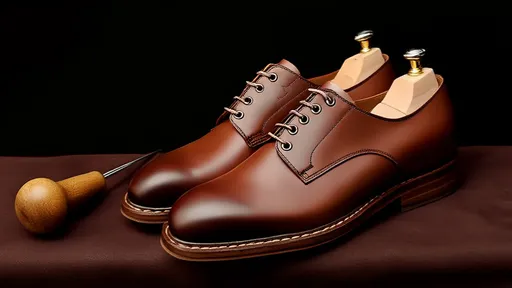
In the quiet workshops of Italy’s historic shoemaking districts, time moves differently. Here, the art of crafting leather shoes by hand isn’t just a profession—it’s a legacy. For generations, families have passed down techniques so precise that they border on the sacred. The whisper of a needle through supple calfskin, the rhythmic tapping of a hammer shaping the sole, the faint scent of vegetable-tanned leather—these are the elements of a tradition that refuses to fade, even in an age of mass production.
The story of Italian handmade shoes begins with the raw materials. Unlike factory-produced footwear, which often relies on synthetic substitutes, true artisans select hides with the care of a sommelier choosing a vintage wine. The leather must be flawless—free of scars, with an even grain and just the right thickness. It’s then treated using natural tannins extracted from chestnut or quebracho trees, a process that can take weeks but results in leather that breathes and ages like living skin. This obsession with materials isn’t merely about aesthetics; it’s about creating footwear that molds to the wearer’s foot over years, becoming more comfortable with each step.
Perhaps the most defining characteristic of these shoes lies in their construction. The Norwegian welt, a technique involving a visible stitching thread that wraps around the sole’s edge, isn’t just decorative—it allows for multiple resoles, extending the shoe’s lifespan for decades. Similarly, the hand-lasted process, where the upper leather is stretched over a wooden form for 48 hours, ensures the shoe retains its shape permanently. These methods require patience; a single pair can take 30 hours to complete, with artisans sometimes redoing stitches until the tension is perfect to the millimeter.
Behind every stitch is a philosophy. Master shoemakers speak of their craft in almost spiritual terms—the needle must follow the leather’s natural pull, not fight against it. They describe how the temperature and humidity of the workshop affect the leather’s behavior, requiring subtle adjustments throughout the day. This intuitive understanding can’t be taught in schools; it’s earned through years of silent observation, of blistered fingers and discarded prototypes. As fourth-generation cobbler Luca Fiorentino puts it, "We don’t make shoes for feet. We make them for souls."
Yet this tradition faces existential threats. The average age of master shoemakers in Naples’ famed San Gregorio Armeno district now exceeds 60, with fewer young people willing to endure the apprenticeship’s grueling early years. Meanwhile, counterfeiters flood markets with "handmade" labels attached to machine-produced imitations, diluting the craft’s value. Some workshops have responded by offering immersive experiences—clients can now visit to select leathers and witness their shoes’ birth, creating emotional connections that no algorithm can replicate.
What endures is the footwear’s silent language. A true Italian handmade shoe communicates through the slight irregularities that prove human hands shaped it—the barely perceptible asymmetry that accommodates how real feet differ, the subtle variations in stitch density where the leather required more reinforcement. In a world of disposable fashion, these shoes stand as quiet rebels, their longevity a protest against planned obsolescence. They remind us that some things—like the transfer of knowledge from grandfather to grandson, or the perfect harmony of form and function—can’t be rushed. And perhaps that’s the most Italian secret of all.

By /Aug 13, 2025

By /Aug 13, 2025

By /Aug 13, 2025

By /Aug 13, 2025

By /Aug 13, 2025

By /Aug 13, 2025

By /Aug 13, 2025

By /Aug 13, 2025

By /Aug 13, 2025

By /Aug 13, 2025

By /Aug 13, 2025
By /Aug 13, 2025

By /Aug 13, 2025
By /Aug 13, 2025
By /Aug 13, 2025
By /Aug 13, 2025

By /Aug 13, 2025

By /Aug 13, 2025

By /Aug 13, 2025

By /Aug 13, 2025
